VAT in Oman: the basics for workshops
Oman introduced VAT on 16 April 2021, at a standard rate of 5%. Most workshop services and spare parts are taxed at this rate.
A business must register for VAT when its taxable supplies go over OMR 38,500 a year, or are expected to. Businesses above OMR 19,250 can register voluntarily.
Once a workshop is registered, every taxable job should end with a proper tax invoice, issued within 15 days of the event that requires a tax invoice, such as the supply or receipt of an advance payment. Invoices and other VAT records should be kept for at least 10 years, and the Tax Authority can ask for records in Arabic.
Where workshops get VAT invoices wrong
Many small workshops in Ghala, Wadi Kabir, Sohar and Salalah still write invoices by hand or in a basic Excel sheet. The most common problems are:
- One total with no VAT breakdown. The customer sees one number and cannot tell how much is VAT.
- Missing VAT number. The workshop's VAT registration number is not printed on the invoice.
- No invoice sequence. Invoice numbers are skipped, repeated or written by hand, which makes VAT returns harder to prepare.
- Parts and labour mixed together. One line says "service and repair: OMR 65", with no detail.
- Advance payments forgotten. A customer pays OMR 20 upfront, but the final invoice does not show it.
- Rounding errors. The Omani rial has 1,000 baisa, so amounts should use three decimals, such as OMR 14.500.
Each of these makes life harder at VAT return time, and some can cause problems with fleet customers who need clean invoices to claim their VAT back.
What a workshop VAT invoice in Oman should include
A tax invoice should clearly show:
Header
- The words "Tax Invoice" (فاتورة ضريبية)
- Invoice number in sequence
- Invoice date and date of supply
Supplier (your workshop)
- Legal name and address
- VAT registration number
- Commercial registration (CR) number (recommended)
Customer
- Customer name and address
- Customer's VAT number, if the customer is a VAT-registered business
- Vehicle, plate number and odometer reading (recommended for workshops)
Lines
- Description of each part or service
- Quantity and unit price before VAT
- Amount before VAT
- VAT rate and VAT amount
Totals
- Total before VAT
- Total VAT
- Total payable including VAT, in OMR
- Advance paid and balance due, if any
A bilingual Arabic–English layout keeps the invoice easy to read for local customers, expat staff and the Tax Authority.
Sample filled tax invoice: a fictional Nissan Patrol service
The sample below shows a service and brake job for a Nissan Patrol in Muscat. The workshop, customer, VAT number and vehicle are all fictional.
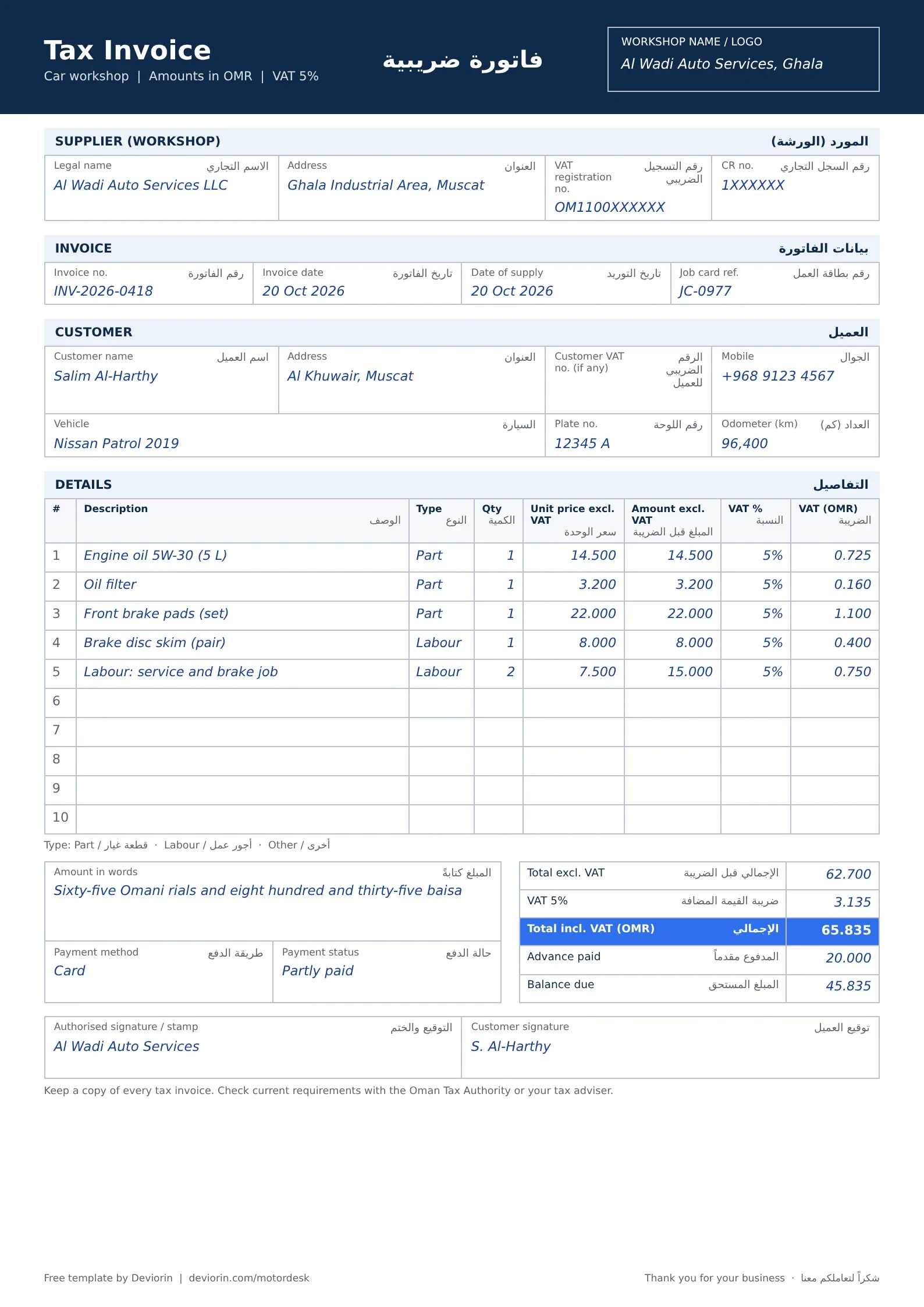
Sample filled tax invoice with fictional workshop, customer and vehicle data.
| Item | Type | Amount excl. VAT (OMR) | VAT 5% (OMR) |
|---|---|---|---|
| Engine oil 5W-30 (5 L) | Part | 14.500 | 0.725 |
| Oil filter | Part | 3.200 | 0.160 |
| Front brake pads (set) | Part | 22.000 | 1.100 |
| Brake disc skim (pair) | Labour | 8.000 | 0.400 |
| Labour: service and brake job (2 hrs) | Labour | 15.000 | 0.750 |
| Total | 62.700 | 3.135 |
Total including VAT: OMR 65.835. The customer paid OMR 20.000 in advance, so the balance due is OMR 45.835.
How to handle parts, labour and advance payments
List parts and labour separately. This makes the invoice easy to check, helps you see how much you earn on labour against parts, and answers the customer's questions before he asks them.
Calculate VAT per line, then total it. Work out VAT on each line and round to three decimals (baisa). The total VAT is the sum of the lines.
Show advance payments clearly. If the customer paid a deposit when the car was dropped off, show the full invoice total first, then the advance paid, then the balance due. Talk to your accountant about how advance payments are treated in your VAT return.
Keep zero-rated or exempt items separate. If any item is not taxed at 5%, show it on its own line with the correct rate, and confirm the treatment with your adviser.
How invoices connect to the job card
The easiest way to get invoices right is to build them from the job card. When the complaint, approved work, parts and labour are recorded on the job card as the work happens, the invoice is just the final, priced version of the same record.
If your team includes Arabic and English speakers, a bilingual job card and a bilingual invoice keep everyone working from the same details.
E-invoicing is coming to Oman
Oman is introducing electronic invoicing (Fawtara) in phases, starting with large taxpayers. Over time, more VAT-registered businesses are expected to issue invoices in a structured electronic format connected to the Tax Authority.
For a small workshop, the practical step now is to move away from handwritten invoices. Clean, numbered, digital invoices with a proper VAT breakdown will make the switch much easier when e-invoicing reaches your business.
Download the free Arabic–English VAT invoice
Use the PDF when you want a printable A4 tax invoice. Use the Excel file when you want the line amounts, VAT, total and balance due calculated automatically, in OMR with three decimals.
Create VAT invoices from your job cards automatically.
See how MotorDesk keeps job cards, parts, labour and invoices together, so your workshop in Oman can bill faster and keep cleaner VAT records.
How MotorDesk helps workshops with invoicing
MotorDesk is Deviorin's workshop management software. A service advisor creates the job card, the team adds parts and labour as the work happens, and the job turns into an invoice without retyping everything.
Each job stays linked to the customer and vehicle, so when a car comes back, the team can see previous work, parts used and payments.
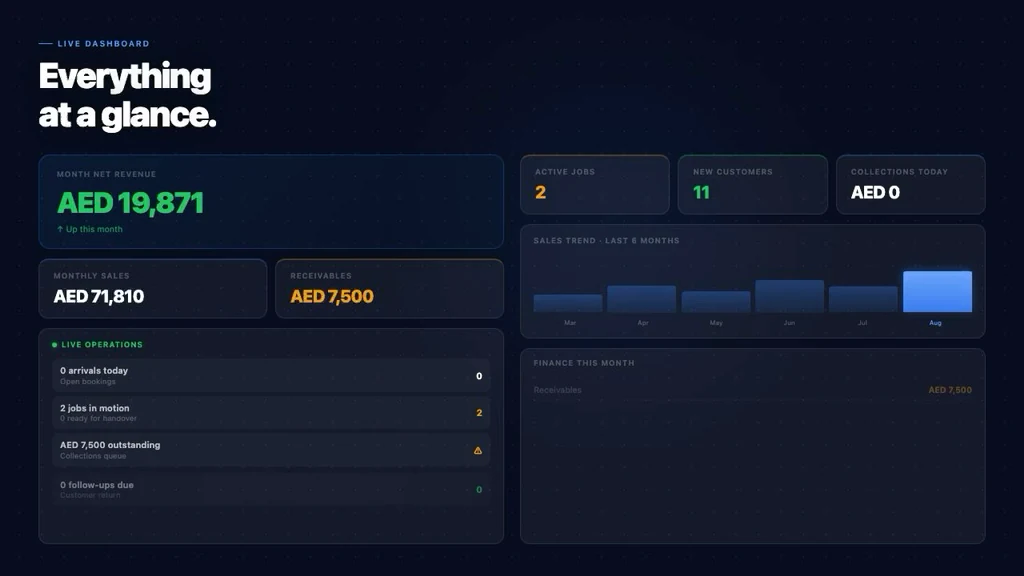
Placeholder: MotorDesk billing screen.
FAQ
What is the VAT rate for car repairs in Oman?
expand_more
The standard VAT rate in Oman is 5%, and it applies to most workshop services and spare parts. Check any special cases with your tax adviser.
Does my workshop have to register for VAT?
expand_more
Registration is mandatory when your taxable supplies go over OMR 38,500 a year. Between OMR 19,250 and OMR 38,500 you can register voluntarily.
Does the invoice need to be in Arabic?
expand_more
The Tax Authority can ask for records in Arabic, so a bilingual Arabic–English invoice is the safest choice. It is also easier for local customers to read.
How many decimals should I use for OMR?
expand_more
Use three decimals, because one Omani rial is 1,000 baisa. For example, write OMR 14.500, not OMR 14.5.
How long should I keep invoices?
expand_more
Keep VAT records, including invoices, for at least 10 years.
Can I send the invoice to the customer on WhatsApp?
expand_more
Yes. Sending a PDF of the invoice on WhatsApp is quick and convenient, but keep your own numbered copy of every invoice for your VAT records.
Create VAT invoices from your job cards automatically.
See how MotorDesk keeps job cards, parts, labour and invoices together, so your workshop in Oman can bill faster and keep cleaner VAT records.
Sources
- Oman Tax Authority: VAT Taxpayer Guide, invoicing requirements
- PwC Worldwide Tax Summaries: Oman, other taxes: https://taxsummaries.pwc.com/oman/corporate/other-taxes
- Aurifer: Oman VAT FAQs: https://aurifer.tax/oman-vat-faqs/
- Oman Tax Authority: https://tms.taxoman.gov.om