The two money leaks in most workshops
Ask any workshop owner in Lahore, Karachi or Rawalpindi where the month's profit went, and the answer is usually one of two things.
Parts. Oil, filters, brake pads and plugs go into cars every day. If even one or two items a day are not written on the bill, the loss adds up to tens of thousands of rupees a month. Owners only notice when the supplier's bill is much bigger than expected.
Udhaar. Regular customers, fleet owners and rent-a-car companies often say "bill bana do, agle hafte de dain ge." Some pay on time. Others pay half, or need five reminders, or are simply forgotten because nobody wrote down the balance.
Both problems have the same cause: the information is in someone's head, a diary or a WhatsApp chat, not in one place that can be checked.
Parts that walk out without a bill
This is how parts usually go missing in a busy workshop:
- A mechanic takes an oil filter from the shelf, but the job card only says "oil change", so the filter is not billed.
- A customer asks for an extra part during the job, and it is added verbally, not on paper.
- Parts are taken for "testing" and never returned to stock.
- Stock is counted once a year, if at all, so nobody knows what is missing.
The fix is simple: every part that leaves the shelf must be written against a job card number. If a part has no job card number, it was not billed.
What to record in a parts stock register
Keep one row for every purchase and every use. The columns that matter:
- Date
- Part name / part number: use exactly the same name every time, such as "Oil filter (Corolla)"
- Supplier (for purchases)
- Qty in and buy price (for purchases)
- Qty used, job card number and sell price (for usage)
- Stock left: after each entry
- Car / customer
- Minimum level: the quantity at which you reorder
At the end of each month, count the shelf and compare it with "stock left" in the register. Any difference is a part that was used without being billed, or a part that went missing.
Sample: a parts register for a fictional workshop in Lahore
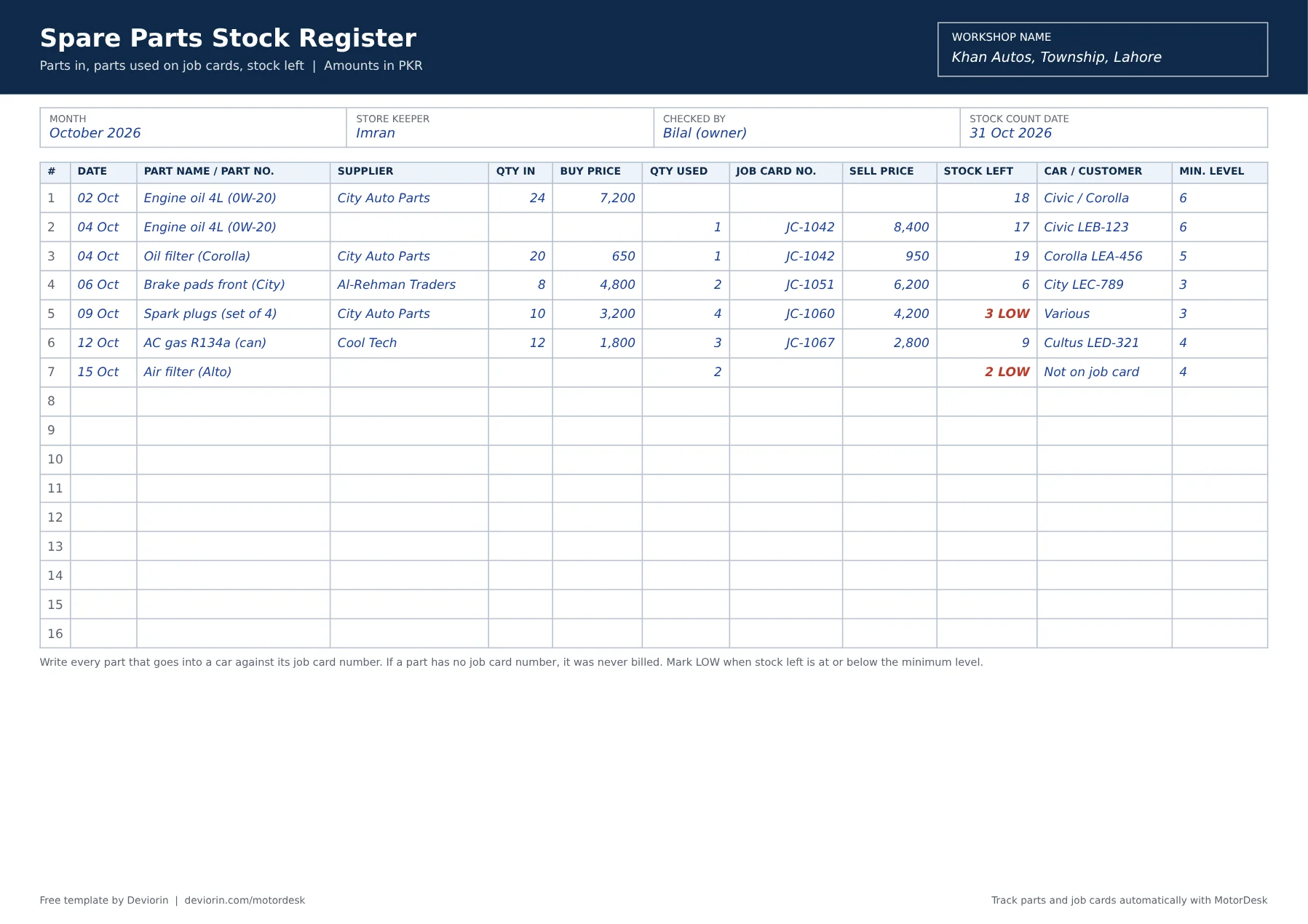
Look at two rows in the sample:
- Spark plugs: 3 sets left, with a minimum level of 3, so they are marked LOW and should be reordered before the next busy day.
- Air filter (Alto): 2 were used, but there is no job card number. That is exactly the kind of row that shows money going out of the workshop without a bill.
In the Excel version, "stock left" and the LOW status are calculated automatically, and any part used without a job card number turns red.
Udhaar: how to give credit without losing money
Credit is part of doing business with regular customers and fleets. The goal is not to stop udhaar. It is to make sure every rupee of it is written down and followed through.
Four simple rules:
- Always write it down the same day. Customer name, WhatsApp number, car, bill amount and how much was paid.
- Always ask for a promised date. "Kis tareekh tak payment ho jaye gi?" A customer who gives a date is far more likely to pay on it.
- Link it to the job card or invoice. If the customer asks what the bill was for, you can show it in seconds.
- Set a limit for each customer. For example, no new credit work until the previous balance is cleared, or a maximum outstanding amount for fleet accounts.
What to record in an udhaar ledger
- Date of the bill
- Customer name and WhatsApp number
- Car and registration number
- Bill amount, amount paid and balance
- Job card or invoice number
- Promised payment date
- Date a reminder was sent
At the top of the ledger, keep two numbers in view: total outstanding and amount overdue by more than 30 days. These two numbers tell the owner more about cash flow than any other report.
Sample: an udhaar ledger
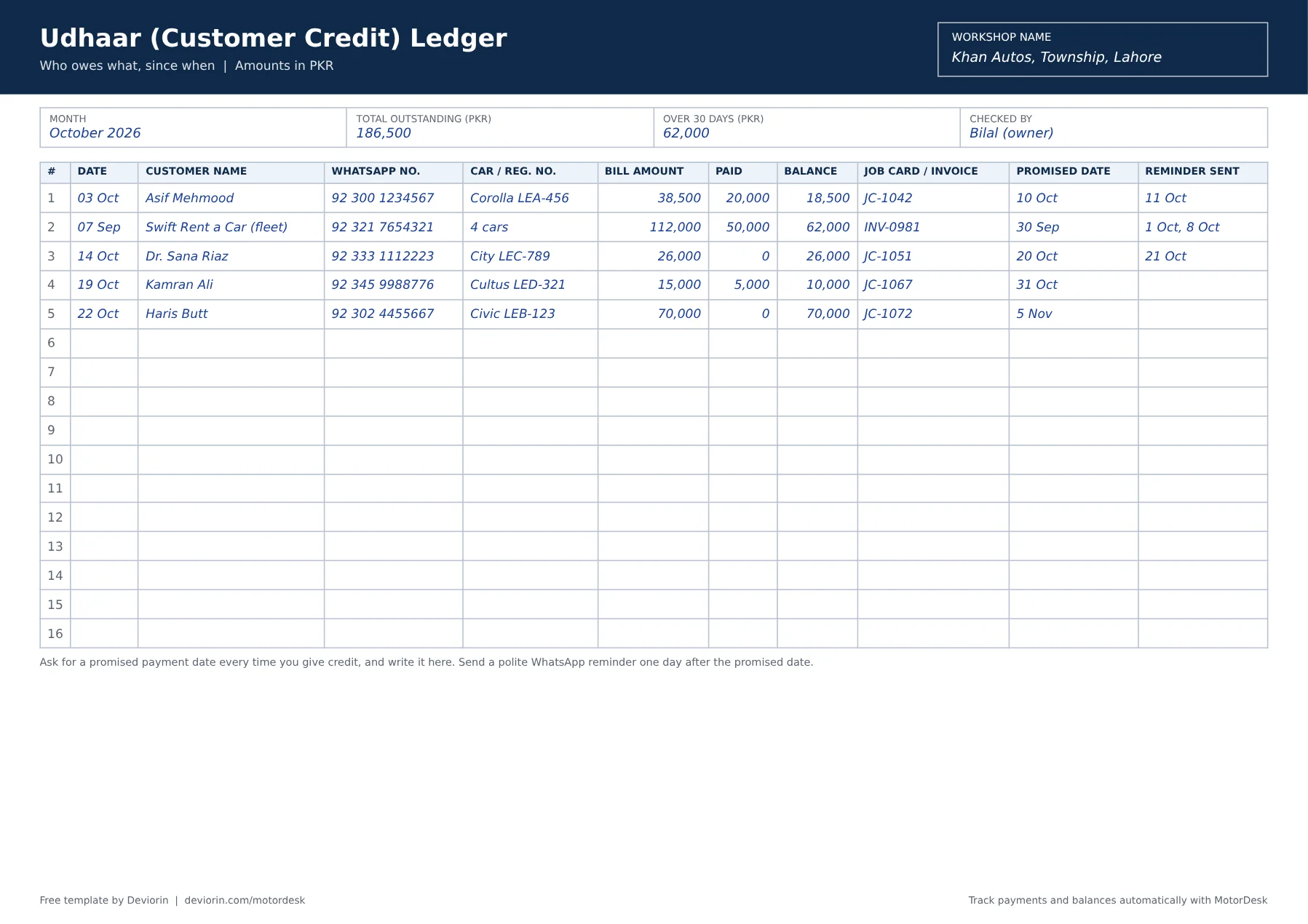
In this example, the workshop has PKR 186,500 outstanding. PKR 62,000 of it is from one fleet customer whose promised date was over a month ago. That one line deserves a phone call, not another message.
In the Excel version, the balance, days overdue and status (Pending, Overdue or Paid) are calculated automatically, along with the total outstanding and the amount over 30 days.
Polite WhatsApp payment reminders
Most customers do not avoid paying on purpose. They forget. A short, polite message on the right day usually solves it. Send the first reminder one day after the promised date.
Keep the tone friendly, mention the exact amount and the car, and always make it easy to pay.
Download the free parts register and udhaar ledger
Use the PDF when you want to print the register and keep it at the parts counter. Use the Excel file when you want stock left, low-stock alerts, balances, days overdue and totals calculated automatically.
Track parts, job cards and payments in one place.
See how MotorDesk links every part to a job card and every job card to a bill, so nothing leaves your workshop unbilled and every balance is visible.
Why registers stop working as the workshop grows
A register works well when one careful person maintains it. It breaks down when:
- Several people take parts from the shelf and forget to write them.
- The same part is written in three different ways ("filter", "oil filter", "OF Corolla"), so the totals do not add up.
- The udhaar diary is in the owner's drawer, and the advisor cannot check a customer's balance before giving more credit.
- Nobody has time to send reminders, so the list of overdue customers keeps growing.
How MotorDesk handles parts and payments
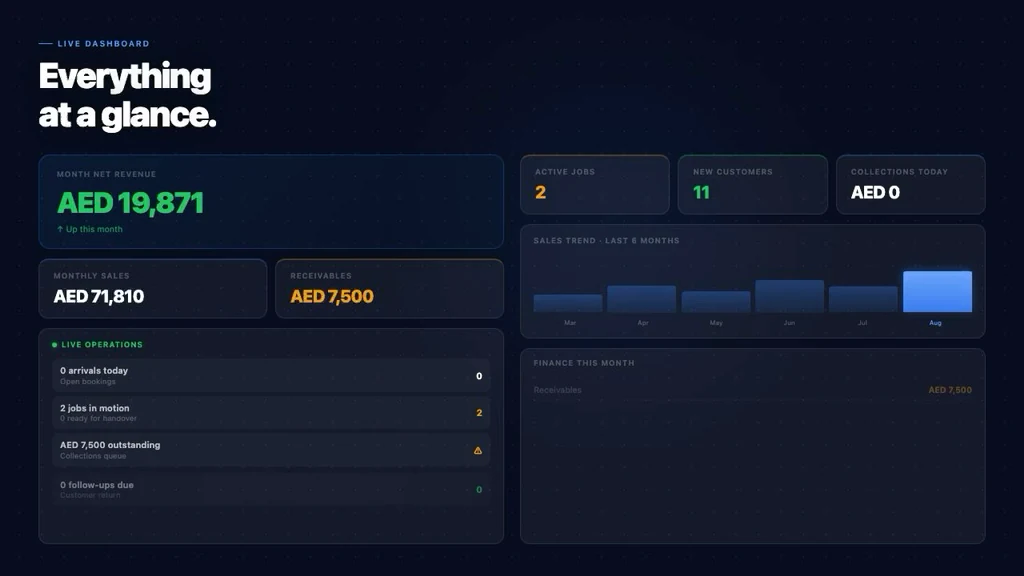
MotorDesk is Deviorin's workshop management software. When a mechanic adds a part to a job card, it comes off stock and goes onto the bill in the same step. Low stock is visible before it becomes a problem.
Every bill shows what was paid and what is pending, so the team can see a customer's balance before starting new work. Combined with WhatsApp service reminders, it helps bring customers back and keeps payments moving.
FAQ
How often should a workshop count its parts stock?
expand_more
Count fast-moving parts like oil, filters and brake pads every week, and do a full stock count at the end of every month. Compare the count with the register and investigate any difference.
What is a good minimum stock level?
expand_more
Set it to what you use in about one week, plus a small buffer. For example, if you use 4 oil filters for a model each week, set the minimum level at 5 or 6.
Should I give udhaar to new customers?
expand_more
It is safer to keep credit for regular customers and fleet accounts you know. For new customers, ask for full payment or an advance before releasing the car.
How should I remind a customer about pending payment without upsetting him?
expand_more
Send a short, polite WhatsApp message one day after the promised date, mention the amount and the car, and give easy payment options. Call only if the payment is still pending after a few days.
Can I use this template on my phone?
expand_more
Yes. The Excel file works in Excel and Google Sheets on a phone. Upload it to Google Drive if more than one person needs to update it.
Track parts, job cards and payments in one place.
See how MotorDesk links every part to a job card and every job card to a bill, so nothing leaves your workshop unbilled and every balance is visible.