Many companies eventually reach a point where spreadsheets, generic software and multiple disconnected platforms no longer support the way they operate. This is where custom software development in Dubai can become a practical option for businesses comparing software development Dubai providers.
A custom software solution can be designed around specific workflows, users, reporting requirements and business goals rather than forcing a company to adapt its processes to a standard product. The right software development company in Dubai should first understand the operation before recommending a platform, app or integration.
Whether you are considering a custom CRM, ERP platform, customer portal, booking system, web application, internal dashboard or workflow automation platform, understanding the development process is important before choosing a software partner.
Deviorin offers custom software development, custom web applications and related software development services for teams that need practical digital systems. You can also view our work or learn more about Deviorin.
What Is Custom Software Development?
Custom software development is the process of designing, developing and maintaining software for the specific requirements of a business or organisation. Unlike off-the-shelf software, which is designed for a broad range of users, custom software is created around a defined workflow, operational problem or business model.
A custom solution may include:
- check_circleCustomer relationship management systems
- check_circleERP platforms
- check_circleInternal business software
- check_circleCustomer portals
- check_circleBooking and appointment systems
- check_circleInventory management systems
- check_circleWorkflow automation platforms
- check_circleBusiness dashboards
- check_circleReporting tools
- check_circleCustom web applications
- check_circleMobile applications
- check_circleAPI integrations
- check_circleIndustry-specific platforms
The objective is not simply to build software. The goal should be to solve a clearly defined business problem.
Why Businesses in Dubai Are Investing in Custom Software
Businesses across the UAE continue to operate in an increasingly digital environment. The UAE Government's Digital Economy Strategy aims to increase the contribution of the digital economy to GDP from 9.7% in 2022 to 19.4% within ten years.
For businesses, this broader shift increases the importance of efficient digital operations, connected systems and better access to business data.
Companies may consider custom software development in Dubai when existing systems create limitations such as:
- check_circleRepetitive manual work
- check_circleDisconnected customer information
- check_circleDifficult reporting
- check_circleLack of automation
- check_circlePoor visibility into operations
- check_circleLimited integrations
- check_circleInflexible workflows
- check_circleDependence on spreadsheets
- check_circleDifficulty scaling existing processes
When Does a Business Need Custom Software?
Not every business needs a custom platform. Many companies can operate successfully using existing SaaS products. Custom development becomes more relevant when the limitations of existing tools begin affecting efficiency, customer experience or business growth.
Your Team Uses Too Many Separate Systems
When customer information, accounting, reporting and coordination live in separate places, employees may need to copy information manually or search several platforms to understand one customer or transaction. A custom system can centralise selected workflows or connect existing tools through integrations.
Employees Spend Too Much Time on Manual Tasks
Software can help automate activities such as creating quotations, updating customer records, assigning jobs, sending notifications, recording transactions, tracking service progress, generating reports, updating inventory, scheduling appointments and processing internal approvals.
Management Cannot Easily Review Business Performance
A customised dashboard can combine selected metrics such as revenue, expenses, profit and loss, sales performance, outstanding payments, customer activity, employee performance, inventory, service volume and branch performance.
Existing Software Does Not Match Your Workflow
Standard software is designed for broad use cases, so the business may have to change its workflow to fit the software. Custom software takes the opposite approach and can be designed around how customers, staff and management actually work.
Your Business Has Unique Operational Requirements
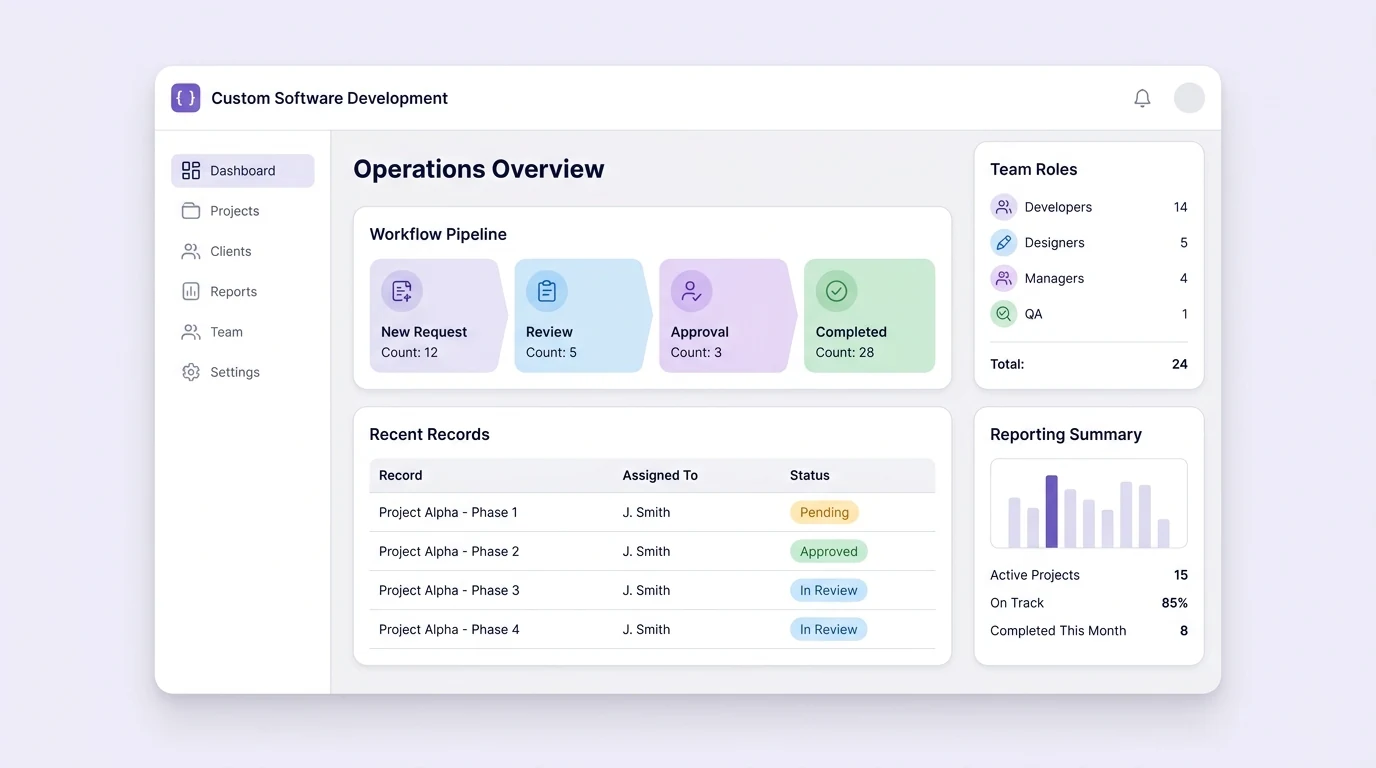
A service company may need separate experiences for customers, employees or technicians, and management: customers book and track services, technicians accept jobs and update status, and management assigns work, monitors revenue, tracks expenses and reviews performance.
Book service -> Select location -> Receive confirmation -> Track progress -> Pay -> View history
Receive request -> Accept job -> Update status -> Upload documentation -> Complete service
View bookings -> Assign employees -> Monitor revenue -> Track expenses -> Review performance -> Generate reports
Custom Software vs Off-the-Shelf Software
Both custom software and ready-made platforms can be appropriate. Standard SaaS products are often suitable for accounting, email marketing, basic CRM, project management, team communication and document storage. They can be faster to implement and may include established support and regular updates.
Custom software is built around specific operational needs. Potential advantages include business-specific workflows, custom integrations, greater control over features, custom user roles, custom reporting, more flexibility and the ability to expand functionality over time.
The trade-off is that custom development requires proper planning, design, development, testing and maintenance. The decision should be based on the business problem rather than assuming custom software is always the better option.
What Can a Custom Software Development Company in Dubai Build?
A capable custom software development company in Dubai should first understand the business requirements before recommending a particular technology. This applies whether the project is handled by a software development company Dubai team, a broader software development company UAE partner or a specialist software development agency.
Custom CRM Development
A custom CRM can help manage lead tracking, customer profiles, sales pipelines, follow-up reminders, communication history, quotations, tasks, sales reporting and customer segmentation around the company's actual sales or service process.
ERP and Business Management Software
A custom ERP or management platform can combine customers, employees, orders, inventory, purchasing, payments, expenses, reporting, operations and branches without copying unnecessary enterprise features.
Custom Web Application Development
Custom web application development gives customers, staff or administrators a browser-based interface for tasks and records. This can include SaaS platforms, portals, marketplaces, booking systems and reporting platforms.
Customer Portals
Customer portals can let clients create accounts, submit requests, book appointments, track orders, view invoices, download documents, make payments and review service history.
Business Dashboards
Dashboards can bring sales, revenue, expenses, profitability, customers, projects, employees, operations, inventory and performance metrics into one interface.
Booking and Service Management Systems
Service companies can manage online booking, location selection, staff scheduling, job assignment, notifications, payments, status tracking, service history and reporting.
Workflow Automation Software
Workflow automation can support approvals, onboarding, invoice processing, document generation, notifications, data entry, employee assignments and reporting.
Mobile Application Development
A mobile app may be useful for customers, delivery teams, technicians, sales representatives, field staff or managers who need frequent access away from a desktop. In some cases, a responsive web app may be more efficient.
Benefits of Custom Software Development for UAE Businesses
Custom software can provide practical advantages when it is planned around real requirements and maintained responsibly after launch.
- check_circleSoftware designed around existing workflows: The system can follow how the company already works instead of forcing staff into generic processes.
- check_circleReduced manual work: Automation can reduce repetitive data entry, status updates, handoffs and reporting tasks.
- check_circleCentralized business information: Selected customer, operational and management information can be organized in one platform.
- check_circleBetter reporting: Dashboards and reports can focus on the metrics that matter to leadership and operations teams.
- check_circleImproved customer experience: Portals, notifications and self-service features can make customer interactions easier to manage.
- check_circleIntegration with existing systems: Custom applications can connect with existing tools when suitable APIs or integration methods are available.
- check_circleGreater control over functionality: The business can prioritize the features it actually needs instead of adapting to unused product modules.
- check_circleAbility to expand over time: A well-structured application can add new user roles, services, reports and integrations as requirements change.
Industries That Can Benefit From Custom Software Development in Dubai
Custom software can be useful when standard platforms no longer match a company's operational workflow. The right solution depends on the industry, users, data and daily processes involved.
Automotive Businesses
Automotive businesses may need online service booking, job cards, technician assignment, customer service history, vehicle records, inventory tracking, quotations, invoices, payment tracking, customer notifications and branch reporting. A focused automotive management platform can connect customer booking, technicians, administration and management reporting without claiming every workshop needs a large ERP system.
Logistics and Delivery Companies
Logistics and delivery teams may need delivery assignments, driver workflows, shipment status updates, customer notifications, route information, proof of delivery, business dashboards, fleet-related data and customer accounts. Custom software can help when delivery work is spread across calls, messages and manual spreadsheets.
Real Estate Companies
Real estate companies may use custom software for lead management, property databases, agent dashboards, follow-up reminders, customer enquiries, viewing scheduling, document management and sales pipeline reporting. The goal is usually clearer sales visibility and faster follow-up rather than more disconnected tools.
Restaurants and Hospitality Businesses
Restaurants and hospitality businesses may benefit from reservation management, customer databases, loyalty systems, multi-branch dashboards, inventory workflows, staff management, reporting and customer feedback tools. A custom platform can be useful when multiple branches or service channels need a shared operational view.
Professional Service Companies
Professional service companies may need client onboarding, project tracking, document management, billing, customer communication, task management and reporting. A custom business application can help teams manage client work from enquiry to delivery and payment.
Healthcare and Appointment-Based Businesses
Healthcare and appointment-based businesses may need scheduling, customer or patient portals, notifications, internal workflows, document management and staff scheduling. Systems handling sensitive or regulated data require appropriate security, privacy and legal review before implementation; this article does not make healthcare-compliance claims.
Custom Software Development for Small and Medium Businesses in Dubai
Custom software is not only for large enterprises. Many SMEs can start with a focused application that solves one operational problem, then expand only when the business case is clear.
For example, a business currently managing jobs in spreadsheets could develop an internal portal where employees can create jobs, assign employees, update job status, add notes, upload documents, record payments and generate management reports.
Before investing, SMEs should compare custom software development services against existing SaaS tools. Custom development makes more sense when available products cannot support the workflow, reporting, integration or user experience the business needs.
Custom CRM, ERP and Web Application Development in Dubai
Custom CRM Development in Dubai
Custom CRM development in Dubai may be appropriate when a generic CRM cannot support how leads, sales representatives, proposals, follow-ups and customer retention actually work.
A typical lifecycle may look like: Lead received -> Lead assigned -> Contact attempted -> Meeting scheduled -> Proposal generated -> Follow-up -> Sale completed -> Customer retained. Features can include lead sources, sales stages, follow-up reminders, customer history, quotations, documents, notes, supported integrations, sales dashboards and conversion reporting.
Custom ERP Software Development
ERP software connects core business operations such as sales, purchasing, inventory, customers, suppliers, employees, operations, expenses, payments and reporting. A custom ERP platform may be useful when the business needs operational control that standard software cannot provide.
Scope should usually be phased. Businesses should avoid building unnecessary modules and focus first on the processes that create the most operational value.
Custom Web Application Development in Dubai
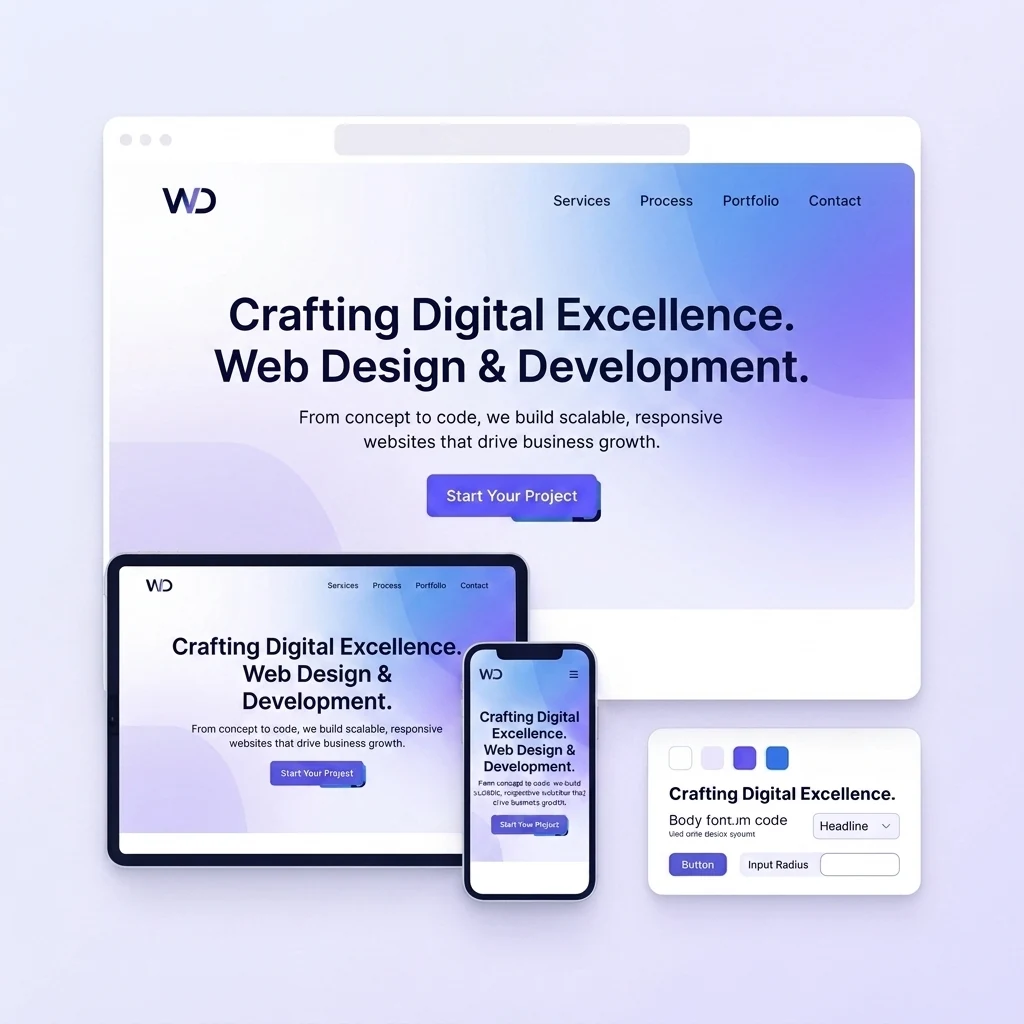
A website usually presents information. A web application lets users perform tasks, manage data and interact with a business workflow. Custom web application development in Dubai can include SaaS platforms, customer portals, employee portals, management dashboards, booking systems, business applications, marketplaces and reporting platforms.
Planning should consider browser-based access, responsive design, hosting, architecture, security and performance. Deviorin's web application development work is structured around the required user journeys and business processes.
Need Software Built Around Your Business?
If your team relies on manual processes, disconnected systems, or software that no longer fits your workflow, Deviorin can help you define and develop a solution around your requirements.
SaaS, Business Automation and Software Integration
SaaS Development for UAE Businesses
Software as a Service lets customers access a product online, usually through accounts, dashboards and subscription or usage-based access. SaaS development Dubai projects may include registration, authentication, subscriptions, user roles, billing integration, customer dashboards, admin dashboards, notifications, usage tracking and reporting.
Before development, define the target customer, problem being solved, value proposition, essential first-version features and monetisation model. Demand should be validated before building a very large platform.
Business Process Automation in Dubai
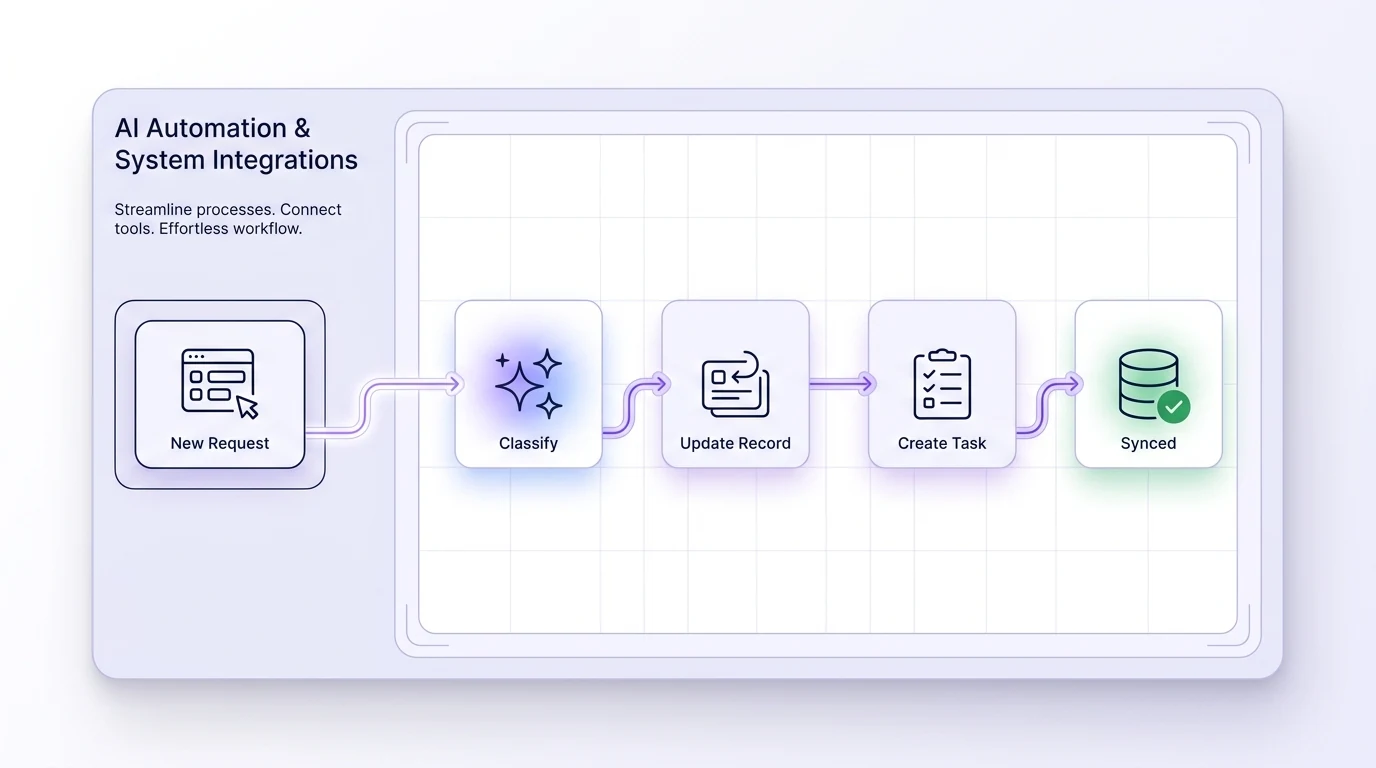
Business process automation can reduce repetitive work such as transferring information between systems, updating records, sending notifications, generating documents, assigning work, preparing reports, requesting approvals and updating customer data.
Businesses should improve inefficient workflows before automating them. Workflow automation Dubai projects and business automation software are most valuable when the underlying process is clear.
API Integration and Software System Integration
Businesses may not need to replace all existing software. A software integration company Dubai project may connect supported systems through APIs, webhooks or other integration mechanisms.
Integration categories can include payment gateways, accounting systems, CRM platforms, email services, SMS services, maps and location services, customer support tools, analytics platforms, ERP platforms and other third-party business platforms. Feasibility depends on whether the external platform provides a suitable API or supported integration method.
Signs Your Current Business Software Is Holding You Back
Employees Enter the Same Information More Than Once
Duplicate entry across spreadsheets, email, accounting tools or CRMs increases the chance of errors and makes it harder to know which record is current.
Important Information Lives in Spreadsheets
Spreadsheets are useful, but they can become difficult for multi-user operational workflows when several teams need permissions, status changes, attachments, reporting and history.
Customers Must Contact Staff for Simple Updates
Customer portals and automated notifications can reduce repetitive calls and messages when customers only need status, booking, payment or document updates.
Reports Take Hours to Prepare
Reliable centralized operational data can reduce manual report preparation and give management a clearer view of sales, payments, jobs, customers and service performance.
Your Software Cannot Support New Services
New branches, new services, additional customer types, increased transaction volume or changing workflows can expose limitations in software that once worked well.
Features to Consider in a Custom Business Application
Feature planning should come from the workflow, not from a generic checklist. The following capabilities are common in business applications, portals and dashboards.
Role-Based Access
A custom business application may need separate permissions for administrators, managers, employees, customers and suppliers so each user sees the right actions and records.
Real-Time Dashboards
Near real-time or regularly updated dashboards can help teams monitor bookings, revenue, tasks, inventory, service performance and customer activity without waiting for manual reports.
Notifications
Notifications can support new bookings, payment confirmations, job assignments, completed tasks, customer requests and approvals.
Search and Filtering
Search and filtering help users locate customers, transactions, jobs, documents and records quickly as data volume grows.
Reporting
Reports may cover revenue, sales, customers, operations, employee activity, inventory and service performance.
Audit Logs
Logging important actions can help teams understand who changed a record, when a status changed and how a workflow moved through the system.
Multi-Branch Management
Multi-branch software can support central management while still giving branch teams access to the customers, inventory, jobs and reports relevant to their location.
Cloud-Based Custom Software
Many business applications can be delivered using cloud infrastructure, giving users access through a browser across supported devices. Planning should consider hosting architecture, availability, storage, backups, security, performance, data-location requirements and scalability.
Cloud hosting is not automatically safer or cheaper. The right approach depends on the application's users, data, integrations, uptime needs and operating budget.
Custom Software Development vs No-Code and Low-Code Platforms
No-Code or Low-Code May Be Suitable When
No-code or low-code platforms may work for simple workflows, prototypes, supported integrations, limited custom functionality and modest usage requirements.
Custom Development May Be More Appropriate When
Custom application development may be more appropriate for complex workflows, advanced integrations, specialised functionality, demanding performance requirements, greater architectural control and long-term product evolution.
How to Choose the Best Software Development Company in Dubai
Selecting a development partner should involve more than comparing quotations. The cheapest proposal is not necessarily the most cost-effective solution if the finished software fails to address the business problem.
1. Evaluate Their Discovery Process
A development company should understand how your business operates, who will use the software, what problems exist today, which workflows need improvement, which systems are already in use, which data needs to be captured, what should be automated and how success will be measured.
2. Review Relevant Software Projects
Look for experience with business applications, dashboards, portals, SaaS products, mobile applications, automation, API integrations and complex workflows. The goal is not always an identical project, but evidence that the team can design the system you require.
3. Evaluate UI and UX Capabilities
Software must be usable as well as technically functional. Ask how the company approaches user flows, navigation, responsive design, accessibility, dashboard design, user roles and mobile interfaces.
4. Discuss Scalability
Ask how the application can handle future users, branches, services, transactions, integrations and reporting requirements without building every possible future feature from day one.
5. Ask About Security
Discuss authentication, permissions, data protection, encryption, API security, backups, logging, infrastructure and access controls according to the information the application will process.
6. Clarify Source Code Ownership
Ownership of source code, design files, databases, intellectual property, hosting accounts, domains and third-party licences should be defined clearly before development begins.
7. Understand Post-Launch Support
Ask how bugs, maintenance, security updates, infrastructure changes, new features, integrations, performance issues and technical support are handled after launch.
Custom Software Development Process
Every software development agency has its own process, but a structured project generally includes several stages.
Step 1: Business Discovery
The development team learns about the company, users, workflows and existing problems so the project solves the right issue.
Step 2: Requirements and Planning
The project is translated into requirements, user stories, feature lists, process maps, technical specifications and milestones.
Step 3: UX and UI Design
Wireframes, user flows, dashboards, forms, navigation, mobile interfaces and prototypes help identify usability problems early.
Step 4: Development
Developers build the application, backend systems, database and integrations, often in phases so important functionality can be reviewed.
Step 5: Testing
Testing may include features, user flows, browsers, responsiveness, integrations, permissions and performance.
Step 6: Deployment
The software is configured for production, with data migration, domains, servers and third-party integrations handled where required.
Step 7: Maintenance and Improvement
After launch, real usage can guide new features, automation, reports, performance improvements, integrations and UX refinements.
How Much Does Custom Software Development Cost in Dubai?
There is no universal price for custom software development. The cost depends on requirements such as the number of features, number of users or roles, application complexity, integrations, database requirements, mobile functionality, UI and UX requirements, third-party APIs, security, reporting, testing, infrastructure and maintenance.
A basic internal application and a large multi-user SaaS platform are completely different projects. Businesses should be cautious of fixed pricing provided without proper requirements gathering. A credible software development estimate should be based on a defined scope.
Questions to Ask a Software Development Company Before Hiring
- How will you understand our current workflow?
- What technology will you use and why?
- How will the system handle future growth?
- Who owns the source code?
- How will our data be protected?
- How will project progress be communicated?
- How are changes to the scope handled?
- What testing is included?
- What happens after launch?
- What maintenance and support options are available?
- Can the platform integrate with our existing systems?
- How will users and permissions be managed?
Clear answers can make it easier to evaluate development partners beyond price alone.
Questions to Answer Before Starting a Custom Software Project
What Problem Are We Trying to Solve?
Describe the operational problem before choosing a technology. A software project should start with the work that needs to improve.
Who Will Use the Software?
List the users involved, such as customers, employees, managers, administrators and suppliers.
What Does the Current Workflow Look Like?
Map the existing process so delays, duplicated effort and handoffs are visible before development starts.
Which Features Are Essential?
Separate must-have features from useful-later features and optional ideas so the first version stays focused.
Which Systems Must Be Integrated?
Identify existing software that may need to connect with the new platform, such as payment, accounting, CRM, email, SMS or ERP tools.
What Information Needs to Be Reported?
Define the management reports and operational metrics that the software should support.
Start With the Business Problem, Not the Technology
A common mistake is beginning a software project with "We need a mobile app." The more useful question is: "What problem are we trying to solve?"
Once the problem is clearly understood, the correct solution may be a web application, mobile application, custom CRM, dashboard, workflow automation, customer portal, API integration or a combination of existing software and custom development. Related Deviorin insights can help frame these decisions before you start your software project.
What Is an MVP in Custom Software Development?
A Minimum Viable Product is a focused first version that solves the core problem reliably with a limited initial scope. It should not be an unfinished or low-quality product.
A service management MVP may initially include customer accounts, bookings, staff assignment, job status and basic reporting. Later phases could add loyalty, advanced analytics, native mobile apps, additional automation and advanced reporting.
Red Flags When Choosing a Software Development Company
No Discovery Process
A proposal created without understanding users, workflows, data and integrations may miss the real business problem.
Unclear Pricing
Pricing should explain scope, phases, assumptions and how changes are handled.
No Discussion of Source Code Ownership
Ownership of code, data, design files, hosting access and licenses should be clarified before work begins.
Poor Communication
Unclear updates, missed decisions and vague responsibilities can create project risk even when the technical team is capable.
No Testing Process
The proposal should explain how key workflows, permissions, responsive behavior and integrations will be tested.
No Post-Launch Plan
Software usually needs maintenance, bug fixes, updates and future improvements after launch.
What Should a Software Development Proposal Include?
Proposal depth depends on project complexity, but a useful proposal should make the business objective, scope and delivery assumptions clear enough for informed review.
- check_circleProject objectives
- check_circleBusiness requirements
- check_circleProposed solution
- check_circleFeatures and user roles
- check_circleTechnical approach
- check_circleIntegrations
- check_circleProject phases and deliverables
- check_circlePricing structure and payment schedule
- check_circleTesting and deployment
- check_circleSupport, ownership terms and scope-change process
Custom Software Development Checklist
Is Custom Software Worth the Investment?
Custom software can be worth the investment when it reduces manual work, improves customer experience, centralises operations, enables digital services, improves reporting visibility, automates repeatable workflows or connects disconnected systems.
It should not be the default answer if an existing product already solves the problem effectively. The practical decision is whether the expected operational value justifies the planning, development and maintenance effort.
Choosing a Custom Software Development Partner in Dubai
When comparing a software development company in Dubai with other software development companies in Dubai, evaluate whether the partner can understand business requirements, translate processes into user flows, design usable interfaces, build maintainable software, integrate systems, plan security appropriately, test the application and provide post-launch support.
Build Software Around Your Business With Deviorin
Deviorin works with businesses to turn operational problems and digital product ideas into practical software solutions. Potential projects can include custom web applications, business management platforms, customer portals, CRM systems, booking systems, dashboards, workflow automation platforms, SaaS applications and system integrations.
The process starts with understanding the business, users, current workflow, operational problem and desired outcome. From there, the project can be scoped around what needs to improve first.
Frequently Asked Questions
What does a custom software development company do?
expand_more
A custom software development company designs and builds applications around the requirements of a specific organisation. This may include business software, web applications, portals, automation systems, CRMs, dashboards and integrations.
How much does custom software development cost in Dubai?
expand_more
There is no single standard cost. Pricing depends on features, integrations, complexity, user roles, design requirements, security, infrastructure and support. A reliable estimate should be based on a defined project scope.
How long does custom software development take?
expand_more
Development time depends on the complexity and scope of the project. A simple internal tool and a large SaaS platform can have very different development timelines.
How do I choose a custom software development company in Dubai?
expand_more
Consider its discovery process, technical capabilities, relevant projects, UI/UX expertise, security approach, scalability, communication, source-code ownership and post-launch support.
What types of custom software can businesses develop?
expand_more
Businesses can develop CRMs, ERP systems, customer portals, booking platforms, workflow automation systems, dashboards, web applications, mobile applications and other industry-specific systems.
Is custom software better than ready-made software?
expand_more
Not necessarily. Off-the-shelf software can be appropriate for standard requirements. Custom software becomes more useful when a business needs specialised workflows, integrations, reporting or functionality.
Can custom software integrate with existing systems?
expand_more
Often, yes. Integration depends on whether the existing platforms provide suitable APIs or other supported integration methods.
Can custom software automate business processes?
expand_more
Yes. Software can automate suitable repetitive processes such as notifications, approvals, job assignment, reporting, data transfer, scheduling and document generation.
Is custom software suitable for small businesses?
expand_more
It can be, particularly when a recurring operational problem is causing enough inefficiency to justify development. Smaller businesses should first determine whether an existing SaaS product can meet the requirement more economically.
Who owns custom software after development?
expand_more
Ownership depends on the contract between the business and development company. Source-code ownership, intellectual property, hosting and licensing should be clarified before development starts.