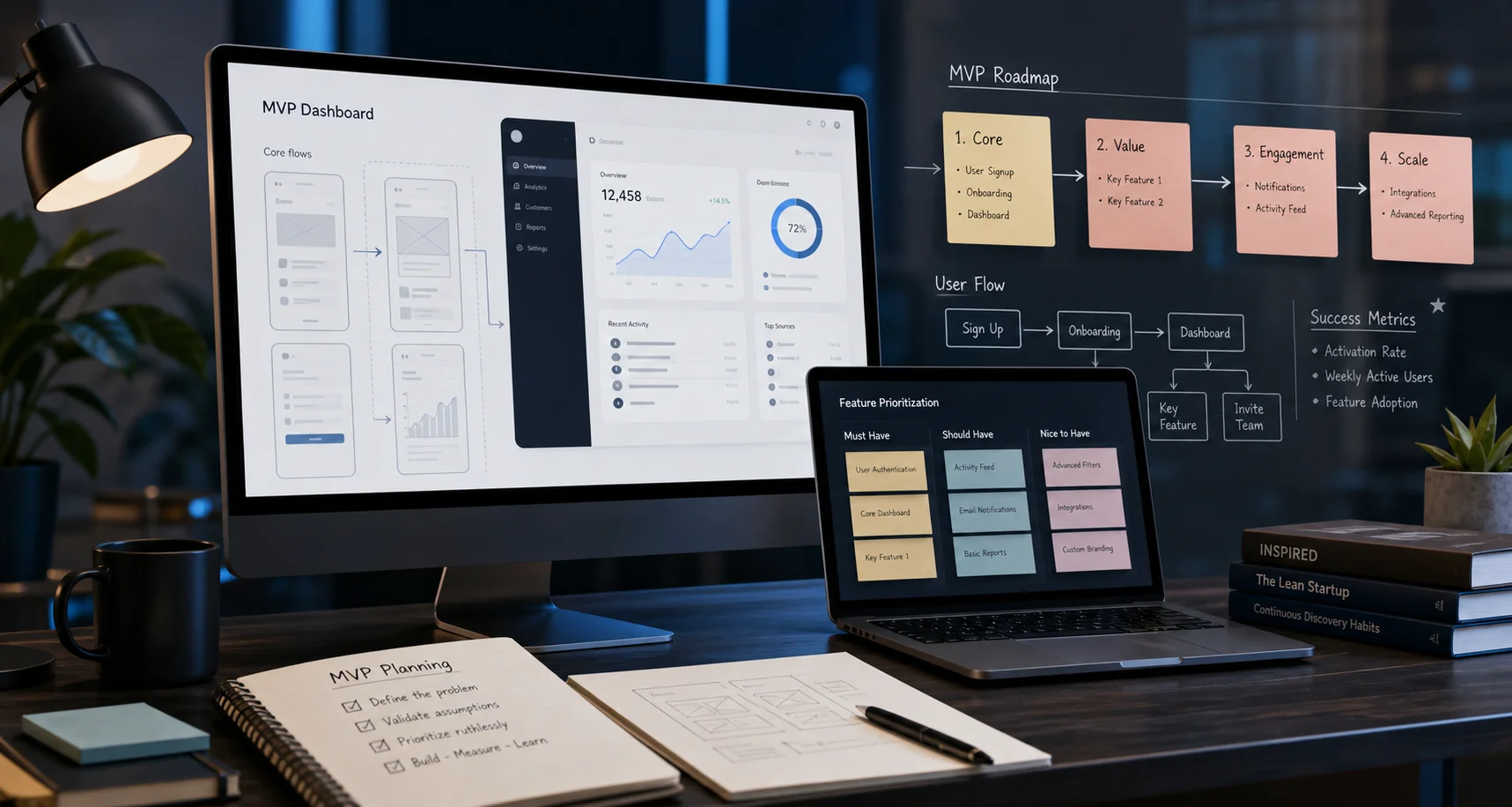
Intro
Many founders and operators say they want an MVP, but what they often mean is “the first version of the product.” Those are not always the same thing.
A strong MVP is not a rushed product, and it is not a low-quality version of a bigger dream. It is a focused version of the product built to answer one important question clearly: does this solve a real problem well enough for the right users to care?
That is where many teams get stuck. They try to launch too much, too early, and end up spending time and budget on features that do not help validate the real opportunity.
What an MVP Is Actually For
The goal of an MVP is not to impress everyone. The goal is to learn something useful from a real release.
A useful MVP should help answer questions like:
- Will users actually use this workflow?
- Is this problem painful enough to justify a product?
- Which part of the experience matters most?
- What must be improved before expanding the system?
If the first release cannot answer those kinds of questions, it is usually too broad, too vague, or too disconnected from the real user problem.
The Most Common Planning Mistake
The most common MVP mistake is trying to include every feature needed for the future product.
This usually happens when teams think in terms of completeness instead of validation. They add dashboards, settings, filters, multiple user roles, reports, notifications, and edge-case flows before proving the central use case.
That creates three problems:
- development slows down
- costs rise too early
- the launch gives unclear feedback because too many things are changing at once
An MVP should reduce uncertainty, not expand it.
Start With One Core Problem
Before deciding what to build, define the exact problem the MVP is supposed to solve.
That problem should be specific enough that a real user can describe it clearly. For example:
- service requests are being tracked manually across several tools
- early customers cannot book or manage appointments cleanly
- internal staff lacks one dashboard for reviewing incoming work
- founders are spending too much time coordinating a repeated process by hand
If the problem statement is vague, the MVP scope will also become vague.
Define the Core Workflow
Once the problem is clear, identify the one workflow the product must make better.
That workflow is usually more important than the feature list. A product with fewer features but a clean core workflow is more useful than a larger product with scattered value.
For example, an MVP might focus on:
- submit request
- review request
- approve or reject
- update status
- notify the right person
That alone may be enough to prove value. Everything else can come later.
What to Leave Out
Good MVP planning is as much about exclusion as inclusion.
Features that often belong outside the first release include:
- advanced analytics
- deep customization
- secondary user roles
- complex reporting
- broad integrations
- polished but non-essential automation
- rare edge-case handling
Leaving these out does not mean they are unimportant. It means they are not necessary for the first validation step.
What a Strong MVP Usually Includes
A practical MVP usually has:
- one clearly defined user problem
- one main workflow
- the minimum screens needed to complete that workflow
- basic admin visibility
- enough structure to collect feedback and improve
It should be usable, clear, and stable. It does not need to feel huge.
Why Structure Matters Early
Even when the feature set is small, the architecture still matters.
An MVP should not be over-engineered, but it should be organized in a way that allows future improvement. That means thinking carefully about:
- route structure
- data model
- user roles
- operational visibility
- where future features may connect
The first version should not block the second version.
Final Thought
The best MVPs do not try to prove everything. They prove one meaningful thing well.
That requires discipline. It means resisting extra scope, focusing on the real user problem, and building the smallest useful version of the product that can generate clear feedback.
When planned properly, an MVP becomes more than a smaller product. It becomes a decision-making tool for the business.